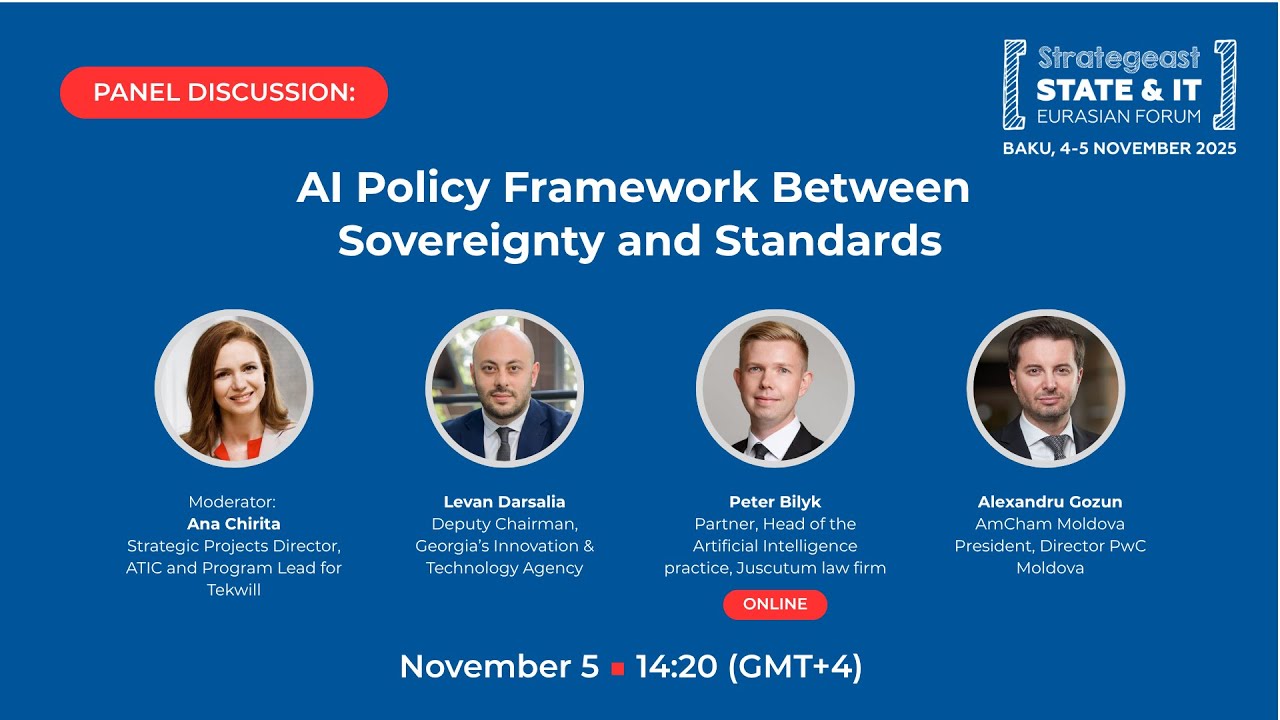
Ana Chirita, Strategic Projects Director at ATIC and Program Lead for Tekwill
“A brief background is important when discussing sovereignty and standards, especially in the context of the AI era and how these issues relate to today’s reality. We see countries that are succeeding, which continue to lead in AI according to multiple assessments, including those cited by ChatGPT. At the same time, there may be strong, less visible advancements in several European countries. Denmark, for example, is making significant progress in the private sector, while France, the United Kingdom, and others are emerging as leaders in developing strong innovation ecosystems.”
Levan Darsalia, Deputy Chairman at Georgia’s Innovation & Technology Agency
“I believe that Georgia interprets AI sovereignty much like most other countries do. The global landscape is such that two countries — the United States and China — control the majority of infrastructure and leading AI models. As a result, everyone else is, to some extent, dependent on these two major players. For Georgia, AI sovereignty means ensuring that we remain up to date with global developments. Both the public and private sectors must keep pace with technological progress, and we must equip ourselves with the capabilities needed to be as self-sufficient as possible. This includes building domestic infrastructure, attracting, training, and retaining talent, and fostering a broad understanding of AI across Georgian society. Our national strategy, which is currently under development, places significant emphasis on AI education as well as upskilling and reskilling the entire population.”
Peter Bilyk, Member of the Expert Committee on AI development in Ukraine under the Ministry of Digital Transformation of Ukraine
“For Ukraine, AI sovereignty is not about isolation—it is about resilient interdependence. Our goal is to protect the state and society under russian attack, safeguard the information space from propaganda, and strengthen national stability. The war accelerated Ukraine’s digital transformation from a years-long effort into one achieved within months, driving our ambition to become a leading country in public-sector AI by 2026.
Our approach is built on three pillars: transforming government into a fully digital state, scaling AI-driven public services, and developing resilient digital infrastructure. We are currently building a national data-processing center and developing a Ukrainian large language model. We have also launched the first government AI agent capable of providing real government services. Ukraine continues to advance dual-use and defense technologies, including tools created by private companies during the invasion to detect disinformation and online manipulation. At the same time, we are aligning with European AI standards, having signed the first international AI convention on protecting human rights. Our goal is to ensure that AI strengthens national security, protects citizens, and opens new opportunities for using this transformative technology.”
Alexandru Gozun, AmCham Moldova President, Director PwC Moldova
“When defining sovereignty — not academically, but practically — I would say it is not about doing everything independently, but about having the ability to choose your standards, your models, your partners, and your implementation architecture. This is the lens through which we should view sovereignty for countries like Moldova. Ultimately, this is a governance question. When each ministry or agency begins developing its own tools, models, pilots, provider networks, and interpretations of compliance, the outcome is not sovereignty — it is fragmentation and chaos. Sovereignty becomes attainable only when strong governance and coordination mechanisms are in place, especially in areas such as data governance, risk assessment, and implementation frameworks. With coherent oversight, standards do not clash; they work together to support a unified national approach. This is what will allow Moldova to embrace new technologies in a way that is coherent, secure, and aligned with the country’s scale and strategic priorities.”